
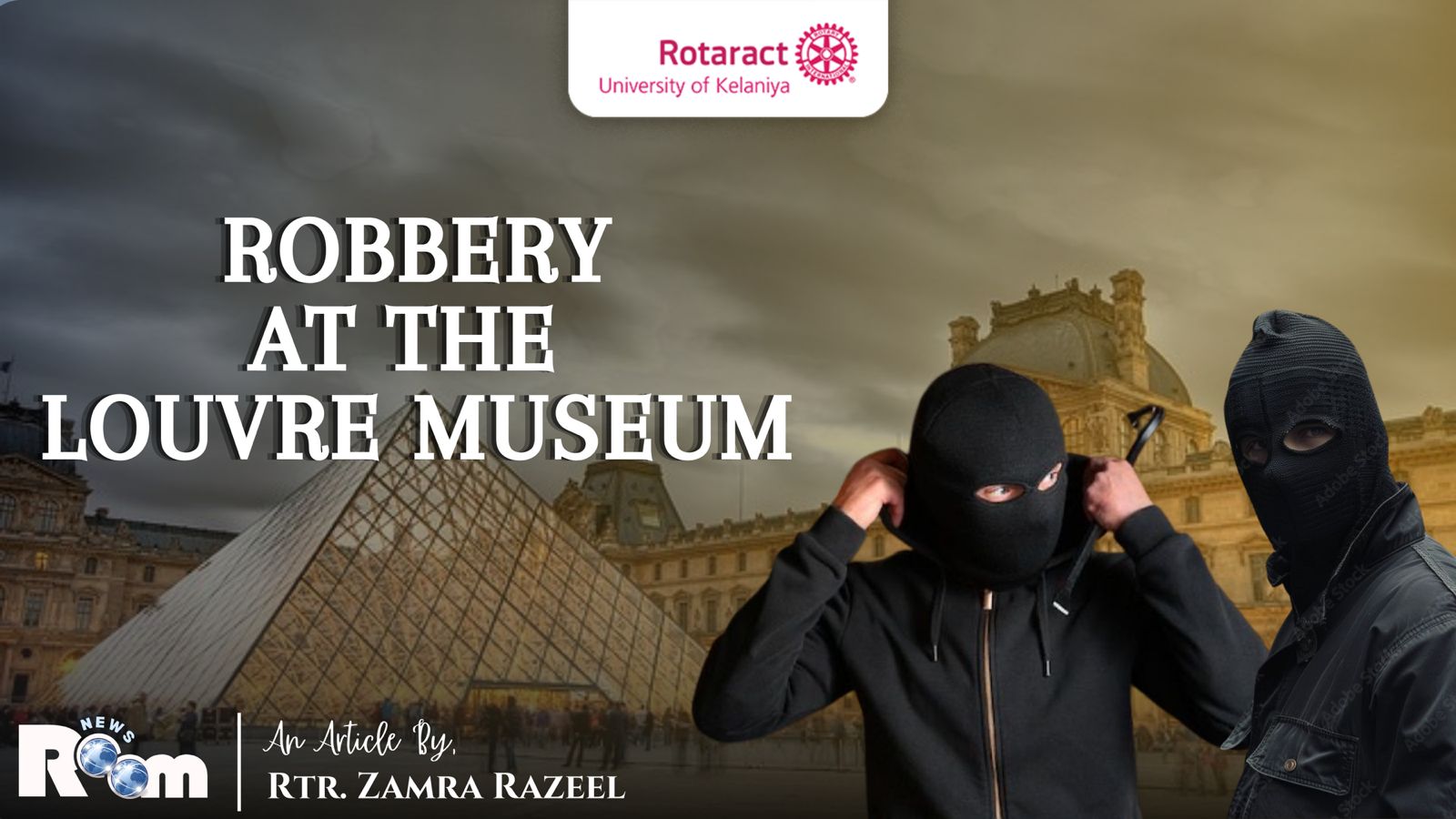
On Sunday, 19th of October 2025, the world awoke to shocking news: the Louvre Museum in Paris, home to France’s royal treasures, had been struck by a daring daylight robbery. Around 9:30 a.m., barely half an hour after the museum opened, a team of four masked thieves carried out one of the boldest heists in modern history. Their target was the Galerie d’Apollon, a glittering chamber created for Louis XIV and housing the remaining French Crown Jewels. The location, close to a Seine-facing façade undergoing construction, gave the criminals the perfect access point for their seven-minute strike.

Investigators believe the group used a vehicle-mounted extendable ladder or furniture hoist to reach a second-floor window. With precision tools, likely including an angle grinder, they sliced through reinforced glass, broke into two high-security display cases, and vanished just as swiftly as they arrived. Witnesses later reported seeing two motorbikes speeding away from the museum grounds, carrying the stolen loot. In their haste, the thieves dropped the Crown of Empress Eugénie, which was later found damaged outside the museum. The Louvre was immediately evacuated and closed to the public while police began one of the largest art-theft investigations in France’s history.


The stolen jewels, eight in total, were valued at roughly €88 million (USD 102 million). Yet their historical worth was far greater. Among them were the sapphire tiara, necklace, and earring set worn by Queen Marie-Amélie and Queen Hortense; the emerald necklace and earrings gifted by Napoleon Bonaparte to Empress Marie-Louise; and the pearl and diamond tiara commissioned for Empress Eugénie by Napoleon III. Other missing items included Eugénie’s diamond “Grand Corsage Bow” brooch, set with more than 2,400 diamonds, and a diamond “Reliquary” brooch with deep religious symbolism. Each artifact represented a fragment of France’s imperial legacy, a glittering record of royal craftsmanship and cultural grandeur.

The heist shocked France and the world alike. President Emmanuel Macron described it as “an attack on a heritage that we cherish because it is our history.” Media outlets called it a national humiliation, especially as it occurred in broad daylight at one of the most secure and visited museums on Earth. In the aftermath, museum staff and unions voiced long-standing concerns about inadequate staffing and outdated security systems. A recent internal audit had already warned of “a worrying level of obsolescence” in the Louvre’s surveillance technology, a warning that now feels chillingly prophetic.
Experts fear that the stolen jewels may never be recovered intact. Their fame makes them impossible to sell whole, leading investigators to suspect that the pieces will be dismantled: the gold melted, and the diamonds re-cut, erasing centuries of royal history in the process. The manhunt is now on a frenzied global footing, with over 100 investigators analyzing crucial DNA and forensic evidence left at the scene, including recovered getaway vehicles. The Audacious Louvre Heist stands as a grim reminder that even humanity’s most treasured creations remain vulnerable. In just seven minutes, thieves stole not only jewels but fragments of a nation’s identity, leaving the world to wonder how secure our shared history truly is, and whether the clock will run out on their recovery.