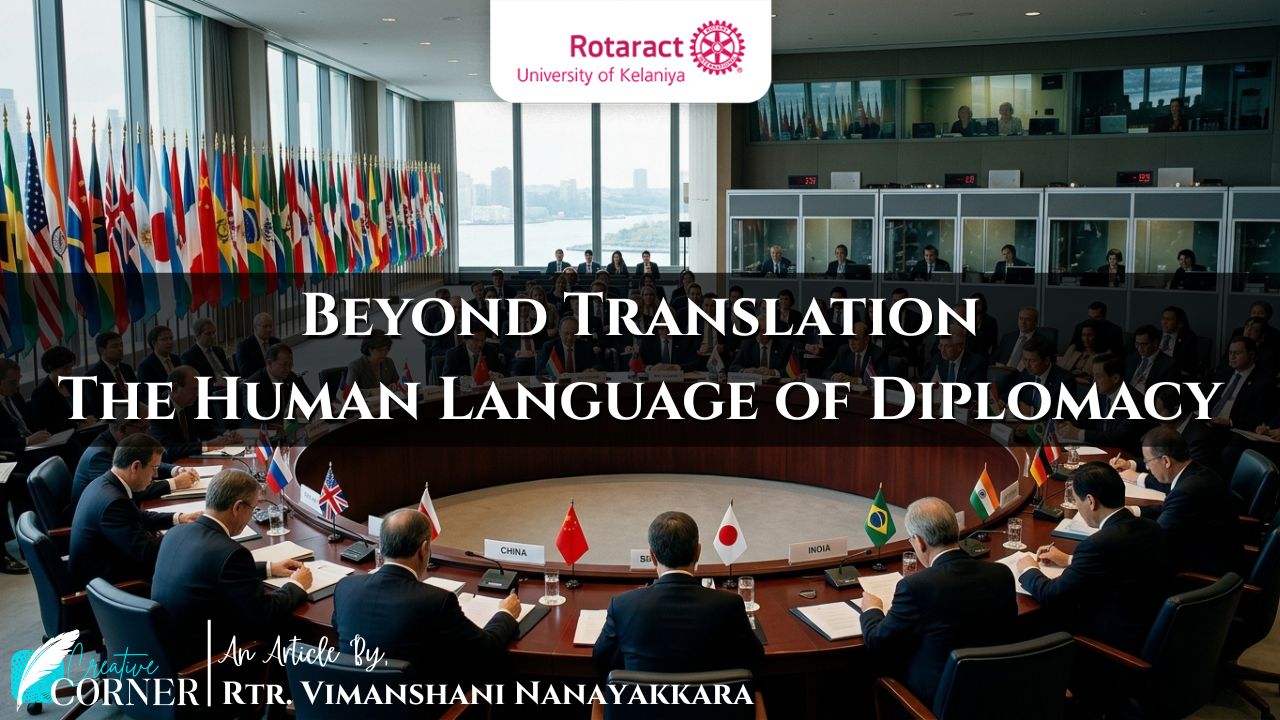
Imagine a room heavy with silence. Around a massive mahogany table sit representatives of nations, people who hold the power to move borders or silence economies with the stroke of a pen. On paper, they are completely synchronized. Everyone speaks a flawless, sanitized English. In the back corners of the room, professional interpreters sit behind glass, their voices a quiet, steady hum through headsets. To anyone watching through a glass partition, this is international relations in full swing. It looks clean, cerebral and highly logical, a giant, elegant game of chess.
But look closer, past the crisp suits and formal agendas. Notice the slight tightening of a jaw when a phrase is translated a little too literally. Notice the hesitation before a handshake. Because international relations is never really a game of chess. Chess is played with cold pieces on a flat board. Diplomacy is played by human beings carrying the weight of their ancestors, their national traumas and their deepest fears. If we try to navigate this fragile web using only a single language or translation software, we are trying to paint a masterpiece in the dark. To understand global politics, you must study the systems. But to truly touch them, you have to understand the language of the person sitting across from you.
We live in an era captivated by convenience. We have algorithms that can translate Mandarin to Spanish in the blink of an eye and earpieces that promise to dissolve barriers instantly. It is tempting to believe that spending years mastering a foreign language is a romantic, outdated pursuit. But this relies on a dangerous assumption: that language is just a code to be cracked.
A machine can accurately translate words, but it cannot translate the ghost that lives inside them. It can give you the literal meaning of a sentence, but it will completely miss the cultural gravity pulling at its edges. Take the simple word “Yes.” To a Western negotiator, “yes” is a contract, it means agreement, it means signing. But in many Eastern cultures, saying “yes” is often an act of hospitality. It simply means, “I see you, I respect you, and I am listening.” It is not a concession; it is an open door. An algorithm cannot feel that shift in temperature. A diplomat who has lived inside that language, however, feels it instantly.
When someone takes the time to learn a difficult language to stumble over its grammar, to mispronounce its vowels, to appreciate its poetry, they are practicing a rare form of cultural humility. They are saying, “I care enough about who you are to step out of my own skin and see the world through yours.” In the cynical, guarded world of geopolitics, where suspicion is often the default, speaking a counterpart’s native tongue becomes an act of quiet intimacy. It breaks down defensive walls and shifts the dynamic from a cold transaction to a living relationship.
Studying international relations gives you the structural map of the world the treaties, the history, the legal frameworks. But studying languages gives you the keys to the rooms where those structures are actually lived. It allows an ambassador to walk away from the cold formality of the microphone, lean in during a coffee break, and drop a quiet, human idiom into the ear of a foreign minister. Those unscripted moments are often where trust is quietly built. The textbooks record the treaties, but it is the human voice that makes them possible.