Every year, as the pilgrimage season begins, thousands of devotees make their way towards Sri Pada. Some climb through the night under a sky full of stars. Others walk alongside family and friends, sharing stories, prayers, and moments of quiet reflection. Regardless of where they come from, they are united by a common purpose ; a journey of faith.
For many Sri Lankans, Sri Pada is more than a mountain.
It is a place where devotion meets determination. A place where generations have climbed in search of spiritual fulfilment, carrying prayers in their hearts and hope in every step.
Yet beyond the chants, the prayers, and the breathtaking sunrise that welcomes those who reach the summit, another story unfolds along these sacred paths – a story that often remains unnoticed.
It is the story of a mountain silently carrying the weight of human neglect.
With thousands of pilgrims visiting Sri Pada each season, the mountain experiences an immense volume of human activity. While the pilgrimage strengthens spiritual connections, it also leaves behind an environmental burden.
Plastic bottles, food containers, polythene bags, wrappers, and other non-biodegradable waste frequently find their way onto the trails. What should remain a symbol of natural beauty and spiritual reverence gradually becomes affected by careless human behaviour.
The scale of the issue is alarming.
During the 2022 – 2023 pilgrimage season alone, approximately 113 tons of waste were collected from Sri Pada and its surrounding areas. Among this waste were nearly three tons of PET bottles, along with several tons of other non-biodegradable materials.
These numbers represent more than statistics.
They reveal the environmental cost of a pilgrimage that should leave behind memories, not mountains of waste.
The vision was simple yet powerful.
To preserve the environmental integrity of Sri Pada while encouraging a culture of responsibility among those who visit it.
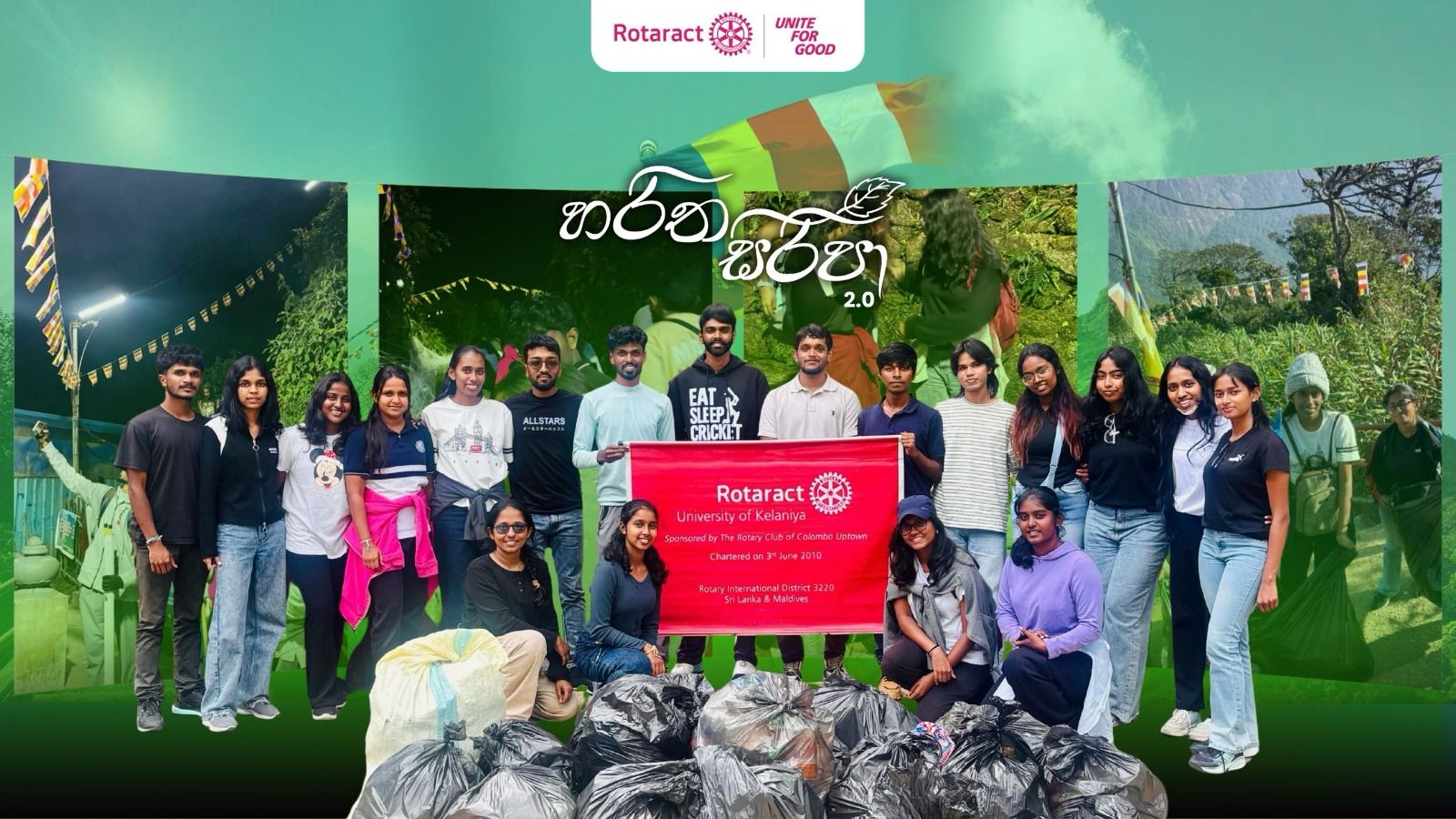
In March 2026, this commitment continued through Haritha Siripa 2.0, the second consecutive year of the initiative. Conducted on the 9th and 10th of March, the project brought together dedicated volunteers who chose to contribute not through words, but through action.
In collaboration with the Rotaract Club of NIBM, approximately thirty Rotaractors embarked on a journey that was very different from the traditional pilgrimage.
They climbed not only as visitors.
They climbed as guardians of a place they deeply respected.
The journey was not easy.
Volunteers travelled along the pilgrimage routes carrying bags, gloves, and determination. As they moved through the trails, they collected waste discarded by countless visitors who had passed before them.
Over the course of two days, nearly thirty bags of garbage were collected from Sri Pada and its surrounding areas.
Inside those bags were hundreds of reminders of a growing environmental problem:
- Plastic water bottles
- Toffee wrappers
- Polythene bags
- Disposable food containers
- Various forms of non-biodegradable waste
Each piece of litter removed from the trail represented something greater than a clean-up effort.
It represented respect.
Respect for nature.
Respect for future generations.
And respect for a sacred place that has given meaning and inspiration to millions.
One of the most powerful aspects of Haritha Siripa 2.0 was not the number of garbage bags collected.
It was the awareness created.
For many volunteers, witnessing the extent of pollution in such a revered location was a deeply emotional experience. The contrast between the spiritual significance of Sri Pada and the environmental damage caused by irresponsible behaviour left a lasting impression.
It became clear that environmental degradation does not happen overnight.
It happens one bottle at a time.
One wrapper at a time.
One careless decision at a time.
And in the same way, environmental restoration begins with small actions as well.
One person choosing not to litter.
One pilgrim carrying their waste back down the mountain.
One volunteer deciding to spend a weekend protecting a place they love.
This collaboration demonstrated the importance of partnerships in creating meaningful environmental impact. Lasting solutions require cooperation between community organisations, volunteers, local authorities, and the public.
Haritha Siripa 2.0 became a reflection of what can be achieved when different groups come together with a common goal.
Because environmental conservation is never the responsibility of one organisation alone.
It is a responsibility shared by all.
The organisers understood that collecting waste was only one part of the solution.
True change requires something much deeper.
It requires changing attitudes.
One of the long-term objectives of the project was to install garbage bins along the pilgrimage routes, providing visitors with convenient and accessible waste disposal options. Although the necessary permissions had not yet been granted by the relevant authorities, the vision remains an important part of the project’s future aspirations.
Because preventing pollution is always more powerful than cleaning it afterwards.
Haritha Siripa 2.0 also embraced a unique approach to environmental advocacy.
Understanding that awareness can be created through inspiration as much as action, the project introduced a photography competition designed to celebrate the beauty and significance of Sri Pada.
Participants were invited to capture the mountain through three themes:
- Nature and Landscape
- Heart of a Devotee
- Climbing
These categories encouraged individuals to see Sri Pada through different perspectives ; not merely as a destination, but as an experience.
Through photography, participants documented the breathtaking scenery, the emotional journeys of pilgrims, and the spirit of determination that defines the climb.
More importantly, they were encouraged to build a deeper connection with the environment itself.
Because people are more likely to protect what they truly appreciate.
The impact of Haritha Siripa extends far beyond one mountain. Across Sri Lanka, numerous culturally and environmentally significant locations face similar challenges as visitor numbers continue to grow.
Projects like Haritha Siripa demonstrate how community-driven action can bridge the gap between awareness and responsibility. They remind us that preserving our natural heritage is not solely the work of environmental organisations or government institutions.
It begins with ordinary people making extraordinary choices.
Choices to care.
Choices to protect.
Choices to act.
As another pilgrimage season comes to an end, the hope behind Haritha Siripa 2.0 continues to grow. The hope that future generations will experience the same beauty, serenity, and spiritual connection that make Sri Pada so special today.
The hope that pilgrims will leave behind prayers instead of plastic.
Memories instead of waste.
Respect instead of damage.
Haritha Siripa 2.0 was never just about collecting garbage.
It was about preserving a legacy.
A legacy that belongs to every pilgrim who climbs the mountain, every volunteer who serves the community, and every citizen who believes that protecting nature is one of the greatest acts of gratitude.
Because when faith guides our journey, responsibility should guide our footsteps.
And through Haritha Siripa 2.0, thirty volunteers took those steps together ; proving that even the smallest actions can leave the most meaningful impact.
Haritha Siripa 2.0 – Sacred Steps. Shared Responsibility. Sustainable Paths.